

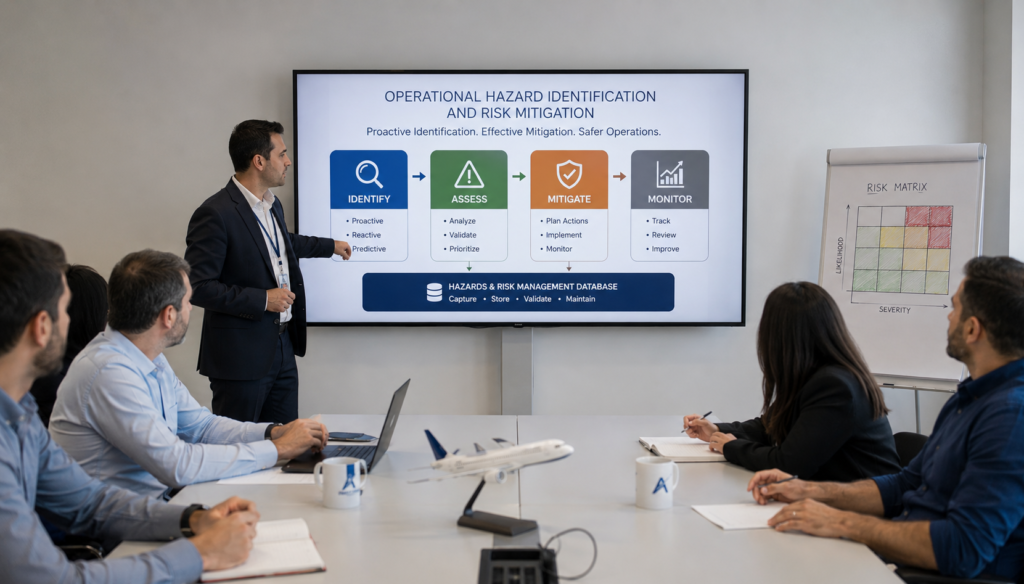
Operational Hazard Identification and Risk Mitigation helps aviation professionals build the knowledge, practical skills, and decision-making mindset needed to manage safety risks in operational environments. The course supports personnel who take part in the implementation, coordination, or oversight of safety risk mitigation activities. It is also designed for those who want to strengthen their ability to identify hazards, evaluate risk information, and support mitigation actions within an effective Safety Management System (SMS). Furthermore, it aligns with the organization’s Hazard Identification and Risk Management (HIRM) Standard Operating Procedures (SOP). The course focuses on the practical use of safety risk management tools in day-to-day operations.
Throughout the course, participants learn how to identify hazards through proactive, reactive, and predictive methodologies. They explore how to capture safety information from operational sources, and they review and validate hazard data. Then, they turn that information into practical risk management action. In addition, the training shows participants how to launch and support Safety Risk Management (SRM) projects for specific hazards. As a result, they can assess issues, document findings, and implement mitigation measures in a structured and consistent way.
The programme also develops practical competence in building and maintaining a Hazards and Risk Management Database. Participants learn how to record hazard information, analyze trends, prioritize risks, and support evidence-based safety decisions. In addition, they examine how organizations select mitigation measures and monitor implementation. Also, they review results to keep risk controls effective over time.
By combining operational examples with a structured SMS perspective, the course helps organizations strengthen hazard identification processes. It also improves the quality of their risk mitigation activities. The course is especially relevant for licensed personnel, operational staff, operational support staff, safety inspectors, and SMS practitioners. These are people who contribute directly to safer operations through a disciplined and data-informed approach to hazard management.
Organizations can also use this course alongside related training in Safety Management Systems, Safety Risk Management, Aviation Safety Investigation, and Safety Performance Monitoring. Together, these programs help build a stronger and more integrated safety framework.